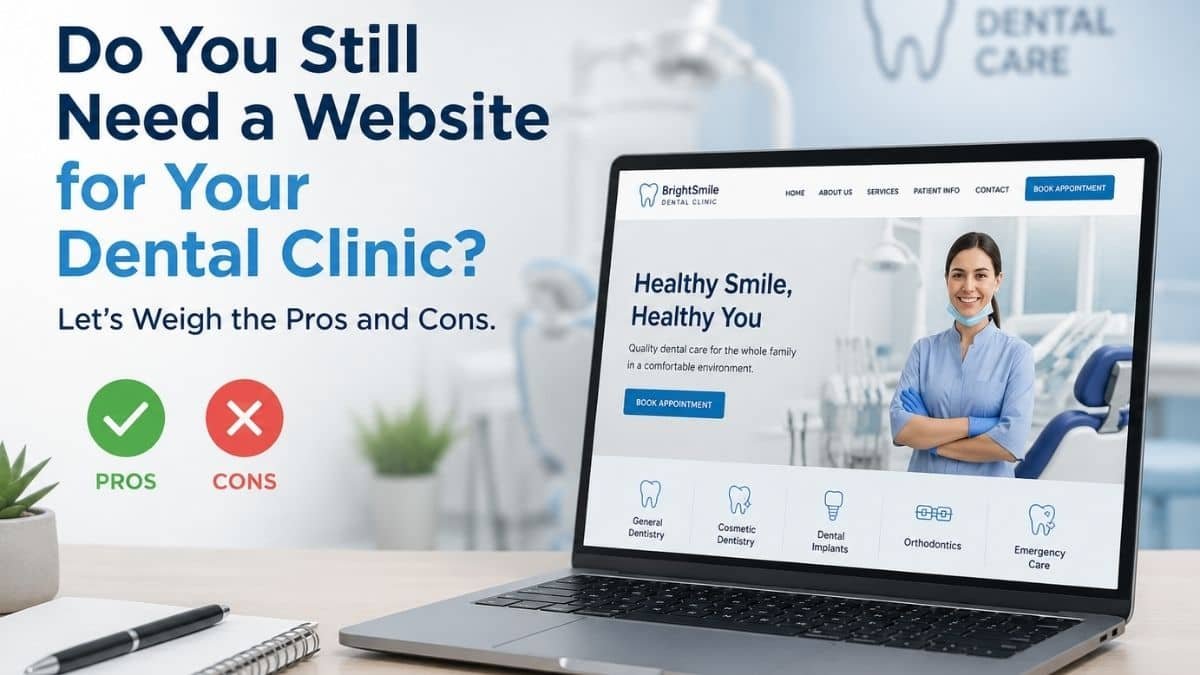
With social media pages, online directories, Google Business Profiles, and appointment-booking platforms, you may be wondering whether your dental clinic still needs its own website.
It is a fair question. After all, many patients can already find your address, phone number, operating hours, reviews, and photos without ever visiting a traditional website.
But does that mean a clinic website is no longer necessary?
Not quite. A website may not be the only place patients discover your practice, but it can still play an important role in building trust, attracting new patients, and supporting your clinic’s long-term growth.
Let’s look at the advantages and disadvantages so you can decide whether maintaining a website makes sense for your dental practice.
The Pros of Having a Dental Clinic Website
1. It Gives You Control Over Your Online Presence
Social media platforms and online directories are useful, but you do not fully control them. Their layouts, policies, algorithms, and features can change at any time.
Your website is different. It is a digital space that your clinic owns and manages.
You decide how your practice is presented, which services are highlighted, what information patients see first, and how visitors are encouraged to contact you.
This control is especially valuable when you want to communicate your clinic’s identity clearly. Whether your practice focuses on family dentistry, cosmetic procedures, orthodontics, implants, or emergency care, your website can explain your strengths without the limitations of a third-party profile.
2. It Helps Build Credibility and Trust
Choosing a dentist is a personal decision. Patients are not only comparing prices or locations. They are also looking for signs that a clinic is professional, reliable, clean, experienced, and approachable.
A well-designed website can answer many of their unspoken questions.
Patients can learn about your dentists, review qualifications, see photos of the clinic, read about your treatment approach, and understand what to expect during their visit.
A clinic with a professional website may appear more established than one that only has a basic social media page. This does not mean a website automatically makes a practice trustworthy, but it gives you more opportunities to demonstrate credibility.
3. It Makes Your Services Easier to Understand
Dental treatments can be confusing to patients. Terms such as root canal therapy, periodontal treatment, veneers, crowns, and dental implants may not be immediately clear.
Your website allows you to explain these services in patient-friendly language.
You can describe:
- What the procedure involves
- Who may benefit from it
- Common signs that treatment may be needed
- What patients can expect before and after the appointment
- Frequently asked questions
- Available payment or financing options
This information can reduce uncertainty and help patients feel more comfortable contacting your clinic.
4. It Can Help New Patients Find You Through Search Engines
When someone searches online for phrases such as “dentist near me,” “emergency dentist,” or “teeth whitening in my area,” a properly optimized website can help your clinic appear in the results.
This is known as search engine optimization, or SEO.
Your Google Business Profile remains extremely important for local searches, but your website can strengthen your overall visibility. It gives search engines more information about your services, location, expertise, and relevance.
For example, separate pages for dental implants, braces, pediatric dentistry, and emergency treatment may help your clinic appear in more specific searches.
SEO is not an instant solution. It requires useful content, technical maintenance, and time. However, it can become a valuable source of patient inquiries over the long term.
5. It Can Make Booking More Convenient
A website can give patients several ways to take the next step.
They may be able to:
- Request an appointment
- Call the clinic with one tap
- Send an inquiry
- View available schedules
- Access directions
- Complete new-patient forms
- Ask about insurance or payment options
The easier it is for a patient to contact you, the less likely they are to leave and choose another clinic.
This is particularly important outside regular business hours. A potential patient may search for a dentist late at night or during the weekend. Even when your reception team is unavailable, your website can still provide information and collect appointment requests.
6. It Supports Your Other Marketing Channels
A website does not have to compete with social media, email marketing, online advertising, or directory listings. It can connect all of them.
Your social posts can link to detailed service pages. Your online advertisements can direct visitors to a focused appointment page. Your email reminders can link to preparation instructions or post-treatment guidance.
In this way, your website becomes the central hub of your digital marketing.
Instead of trying to explain everything in a short post or advertisement, you can guide interested patients to a page where they can learn more and contact your clinic.
7. It Can Save Your Staff Time
Reception teams often answer the same questions repeatedly:
- What time do you open?
- Do you accept walk-ins?
- Do you treat children?
- How much does a consultation cost?
- Do you offer emergency appointments?
- Where can I park?
- What should I bring to my first visit?
A clear website can answer many of these questions before a patient calls.
It will not eliminate phone inquiries, nor should it. Some patients will always prefer speaking with a person. However, making essential information readily available can reduce repetitive conversations and allow your team to focus on more urgent or complex concerns.
The Cons of Having a Dental Clinic Website
1. It Costs Money to Build and Maintain
A professional website involves expenses.
Depending on your needs, you may need to pay for:
- Website design and development
- Domain registration
- Hosting
- Security
- Technical support
- Copywriting
- Photography
- Search engine optimization
- Online booking integration
- Ongoing updates
A low-cost website may be sufficient for a small clinic, but a more advanced site can require a significant investment.
The key question is not simply how much the website costs. You should also consider whether it helps generate appointments, reduce administrative work, or strengthen your brand.
A cheap website that looks outdated and provides little value may be a poor investment. A simple but effective website can often be more useful than an expensive site filled with unnecessary features.
2. It Requires Regular Updates
A website is not something you should build once and ignore for several years.
Clinic hours change. Dentists join or leave the practice. Services, pricing, promotions, contact details, and insurance arrangements may be updated.
Outdated information can frustrate patients and damage trust.
Imagine a patient arriving because your website says the clinic is open, only to discover that your schedule has changed. Even a small error can create a negative first impression.
Someone on your team should be responsible for reviewing the website regularly and ensuring that its information remains accurate.
3. Poor Design Can Work Against You
Having a website is not automatically better than having no website.
A slow, confusing, outdated, or poorly formatted site can make patients question the quality of the clinic itself.
Common problems include:
- Pages that load slowly
- Text that is difficult to read
- Broken links
- Poor mobile design
- Unclear contact information
- Generic stock photos
- Complicated booking forms
- Excessive pop-ups
- Outdated staff profiles
- Overly technical language
Patients often form an impression quickly. If the website feels neglected, they may assume the practice is also behind the times.
4. It May Not Be Your Main Source of New Patients
Some clinics receive most of their patients through referrals, local reputation, insurance networks, hospital affiliations, or a strong Google Business Profile.
In these cases, a large and complicated website may not be necessary.
A small neighborhood clinic with a loyal patient base may only need a straightforward site containing its services, location, dentist profiles, contact details, and booking information.
The goal should not be to have a website simply because other clinics have one. The website should match your actual business needs.
5. It Creates Privacy, Security, and Compliance Responsibilities
Dental clinics handle sensitive patient information.
If your website collects appointment requests, health details, identification information, or insurance data, you need to take privacy and security seriously.
Forms should only request information that is genuinely necessary. Patient data must be handled carefully, and your website should comply with the privacy and healthcare regulations that apply in your location.
You should also make sure the site uses secure connections, reputable software, strong passwords, appropriate access controls, and regular updates.
The more complex your website becomes, the more attention these responsibilities may require.
6. Results Are Not Guaranteed
A website does not automatically produce new patients.
You can spend money on an attractive site and still receive very few inquiries if it is difficult to find, poorly written, or not designed around patient needs.
For a website to perform well, it may need:
- Local SEO
- Accurate business information
- Strong calls to action
- Helpful service pages
- Positive reviews
- Mobile-friendly design
- Fast loading times
- Clear appointment options
- Ongoing promotion
It is better to view a website as part of your overall patient-acquisition strategy rather than as a guaranteed source of bookings.
Can You Rely Only on Social Media?
For some clinics, social media is the most active part of their online presence. It is useful for sharing announcements, patient education, clinic updates, team photos, promotions, and short videos.
However, relying entirely on social media has limitations.
Not every patient uses the same platform. Older patients may prefer search engines, while younger patients may discover clinics through social apps. Some people may see your content but struggle to find detailed information about your services, policies, or dentists.
Social media content also moves quickly. An important post can disappear from view within days, while a well-organized website page remains easy to access.
The strongest approach is usually to let social media create awareness and use your website to provide deeper information and encourage appointments.
What About a Google Business Profile?
A Google Business Profile is essential for many dental clinics. It can display your location, contact details, hours, reviews, photos, directions, and other useful information directly in search results.
For some patients, this profile may provide everything they need to call or visit your clinic.
Still, it does not completely replace a website.
Your website gives you more space to explain treatments, introduce your team, answer questions, present your brand, and guide patients through the booking process.
Your Google profile and website should work together. The profile helps patients discover you, while the website helps them evaluate whether your clinic is the right choice.
When a Simple Website May Be Enough
Not every dental practice needs a large website with dozens of pages.
A simple website may be enough if your clinic:
- Mainly serves a local community
- Relies heavily on referrals
- Offers a limited range of services
- Has a modest marketing budget
- Does not plan to publish content regularly
- Uses external platforms for appointment booking
At minimum, a useful dental website should include:
- Clinic name and contact details
- Address and map
- Opening hours
- Dentist and team information
- Main services
- Appointment instructions
- Emergency contact guidance
- Payment or insurance information
- Privacy information
These essentials can be presented clearly on a small, well-designed website.
When a More Advanced Website Makes Sense
A larger website may be worthwhile if your clinic:
- Operates in a competitive area
- Offers high-value treatments
- Has multiple dentists or locations
- Wants to attract patients through search engines
- Runs paid advertising
- Provides online booking
- Publishes educational content
- Serves several patient groups
- Wants to build a distinct brand
Clinics offering implants, orthodontics, cosmetic dentistry, full-mouth rehabilitation, or other complex treatments may benefit from detailed service pages and patient education resources.
When patients are making a significant financial or healthcare decision, they are more likely to conduct extensive research before contacting a provider.
So, Do You Still Need a Website?
For most dental clinics, the answer is yes, but it does not need to be overly complicated.
A website remains valuable because it gives you control, supports credibility, explains your services, improves patient convenience, and strengthens your other marketing efforts.
At the same time, it requires money, maintenance, security, and a clear strategy. Simply having a website is not enough. It must be accurate, professional, easy to use, and designed around what patients actually need.
The real question is not whether your clinic should have the biggest or most sophisticated website.
It is whether your website helps patients find you, trust you, and take the next step.
For many practices, a focused and well-maintained website will do exactly that.